There's a robot arm on my desk. A few weeks ago it picked up a sock and dropped it into a cardboard box entirely on its own: no joystick, no remote control, no me touching anything. An AI model I trained was running the show. The first time it worked, my wife and I genuinely cheered.
I should mention: I don't come from engineering school (I studied business administration 😅). But I've been writing code for ten years, and these days building software with real customers is my actual job. Robots are new to me; building things isn't. This blog exists because those two paragraphs turned out to be compatible, and I think that's worth writing down as it happens, with the real numbers and the failures left in.
It started with an itch
I've had a geek side longer than a career: I learned HTML at fifteen and built a little job-board website, back in 2002. I started coding for real in 2016, and since around 2020 I've written code every day. The loop never got old: think of a solution, build it, watch it work.
But somewhere in late 2025 I noticed the ceiling: everything I made lived inside a screen. I wanted the loop to end with something moving. So I gave myself a winter of foundations: three or four months, on and off, of electronics and microprocessors. Motors, sensors, Arduino boards, and the unglamorous business of making current do what your code says.
A toy car that could find the TV
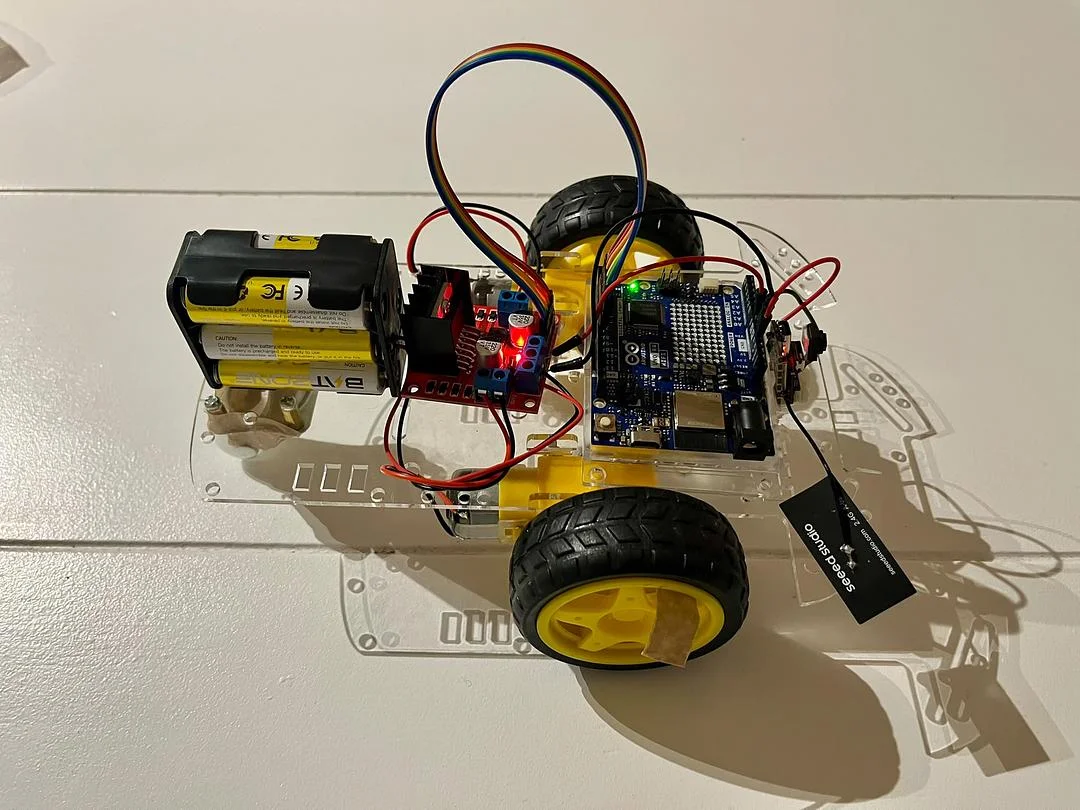
The pet project from that winter was a "self-driving" toy car. It started humbly: a web app with manual controls, driving the car's motors through an Arduino. Then I added a tiny camera, a little black tag on its side that gave it eyes, so I could see the car's view live in the app.
Then came the fun part. Instead of steering it myself, I added a self-driving mode: tell the car "go to the TV," and it would spin slowly in place, scanning its camera feed and analyzing it in real time until it spotted the TV, then drive straight to it. The first time it actually pulled this off, alone in the living room, I understood something: I could make machines act in the world. That little car is what gave me the confidence to buy a robot arm.
Then the arm
The arm is an SO-101, an open-source design by Hugging Face. It's where this blog gets its name: a degree of freedom is one independent way a machine can move, and the SO-101 has six: five motors moving the arm, one working the gripper. The kit is actually two arms: a leader you move by hand and a follower that mirrors you. The first time all six degrees of freedom tracked my hand live, it stopped feeling like a kit and started feeling like a robot.
From there I went to imitation learning: I demonstrated a task (pick up a sock, drop it in a container) 54 times, trained an ACT model overnight on my laptop, and the arm did it by itself. That's the run from the first paragraph. Success rate: about 30%. It fails more than it works, and I'm thrilled anyway. The full story, numbers and all, is coming in its own post.
Why robotics
The honest first reason: it's fun. I thought coding was the fun ceiling: thinking up a solution, building it, seeing it work on the screen. Robotics is that same loop, but in the world of atoms instead of the world of bytes. Your code doesn't just render something; it reaches out and moves an object sitting next to you. Picking things up, putting them down, making a mess of your desk in the physical world. It's more fun than coding, and I didn't think anything was.
The bigger reason: I think this is where AI is headed. Software is automating the digital side of work at a startling pace, but that's a sliver of the real economy; most of the world's value comes from handling, moving, and making physical things. AI reaches its full impact only when it can act out here, and that's robotics. After a career in software and machine learning startups, I can't walk down a street anymore without spotting a dozen "what if a robot could do that" opportunities.
What to expect
Two posts are already on the bench. First, assembling the SO-101: the vendor hunt, the parts that spent weeks crossing an ocean, the camera that never shipped, and the moment the follower arm first mirrored my hand. Then, training the sock task: episodes, configs, training curves, and exactly how far 54 demonstrations gets you. After that: evaluating a fine-tuned π0.5 against ACT, and working toward tasks with real value instead of toy ones.
If you can code, or almost, robotics is closer than you think. That's the bet this blog is making, in public. The newsletter signup is in the footer, the RSS feed is real, and the comments are open. See you in the next post.
Comments
Loading comments…