About this blog
Degrees of Freedom is where I write the journey down as it happens: the hardware I put together, the code that drives it, and the AI I train to make machines move, with detours into robotics startups and how you take a robot to market.
The rule is learning in public: what I built, what it cost, what worked, and the real success rates, not the highlight reel. If you can code but robotics feels out of reach, this blog exists to show you the reach is shorter than you think.
The name comes from the first robotics term I learned: a degree of freedom is one independent way a machine can move. My SO-101 has six motors: five that move the arm, one that works the gripper.
About me
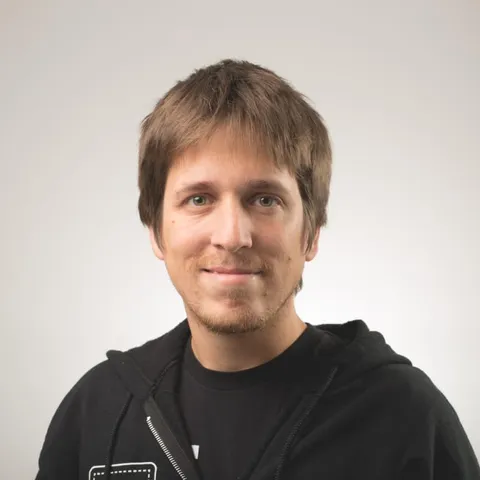
I'm Federico. There's a robot arm on my desk and I've taught it to do things.
Although I'm not an engineer (I actually studied business administration at university), the geek side was always there. In 2002, at fifteen, I learned HTML and built my first website: a small job board where companies could post openings and people could search them. In 2016 I started learning to code properly (python and javascript), and since 2020 I've written code every day, learning the ins and outs of it.
The business side got the head start on my career. In 2014 I co-founded MonkeyLearn, a machine learning startup for analyzing text at scale. Customers like Snapchat, GitHub, Salesforce, Atlassian, and Stanford University used it to analyze customer feedback, support tickets, and other text data, pulling out insights and automating manual work. For more than seven years I was COO, leading go-to-market across marketing, sales, operations, and customer success. MonkeyLearn was later acquired by Medallia.
After that I ran marketing at Hugging Face while open-source AI was taking over the world. When I joined we were fewer than 30 people, valued at under $300 million, with only one person working on the business side and less than half a million dollars in revenue. While I was there we grew revenue to $20 million a year, the team passed 200, and we raised a $100 million Series C; by the time I left, the company was valued at $4.5 billion. MonkeyLearn taught me how to build a successful startup. Hugging Face showed me what a rocket ship feels like from inside.
But where I really learned to build and ship software was becoming a solopreneur, building WordCrafter (an AI content platform for SEO teams), Signaly (LinkedIn lead generation), and Crowd Intelligence (audience research mined from Reddit). Products with real customers, where I had to learn frontend, backend, databases, infrastructure: the whole thing.
Robotics started in late 2025, with the realization that code on a screen was no longer the interesting frontier. I spent three or four months on electronics and Arduino foundations: motors, sensors, making things happen off-screen. The pet project was a “self-driving” toy car with a tiny camera for an eye that could find the TV on its own. It worked, and that's what gave me the confidence to buy an SO-101, the open-source robot arm designed by Hugging Face.
I assembled it, calibrated it, and learned to teleoperate it. My desk was a mess for the first run, and honestly it still is. Then I recorded 54 demonstrations of one deliberately simple task (pick up a sock, drop it in a cardboard box) and trained an ACT model overnight on my MacBook, about 24 hours. The arm did the task on its own. The first time it worked, my wife and I genuinely cheered. The success rate was about 30%: it fails more than it works, and I was thrilled anyway. Fifty-four examples and one overnight run taught a machine a physical task. Since then I've fine-tuned π0.5, a much bigger model, on a rented GPU in the cloud, because my laptop wasn't enough for that one.
Why robotics? First, because it's the most fun I've ever had building things: coding that reaches out of the screen and moves objects next to you. Second, because I think it's where AI is headed. Software is automating the digital world fast, but most of the world's real value is physical: moving, handling, making. AI reaches its full impact when it can act out here. As an entrepreneur, I can't unsee that.
What's next
Proper evaluations of the fine-tuned π0.5 against ACT, then tasks with real value instead of toy ones: clearing the table, tidying up, and the one I actually dream about, a robot that prepares my mate. (I'm Uruguayan. The mate doesn't stop just because I live in Berlin.) There's also RoboPlay, an open-source SO-101 simulator for the browser, taking shape as the next big build. The arm is just getting started.
Get in touch
Questions about any of this are welcome. I'm happy to share what I've learned so far.