What it is
Once you're training more than one policy (ACT first, then a fine-tuned π0.5) you end up with a pile of runs, checkpoints, and rollouts, and no honest way to compare them. RoboLab is my answer: a self-hosted web app that turns that mess into a cockpit. Training and Evaluation are fully built; Inference is next.
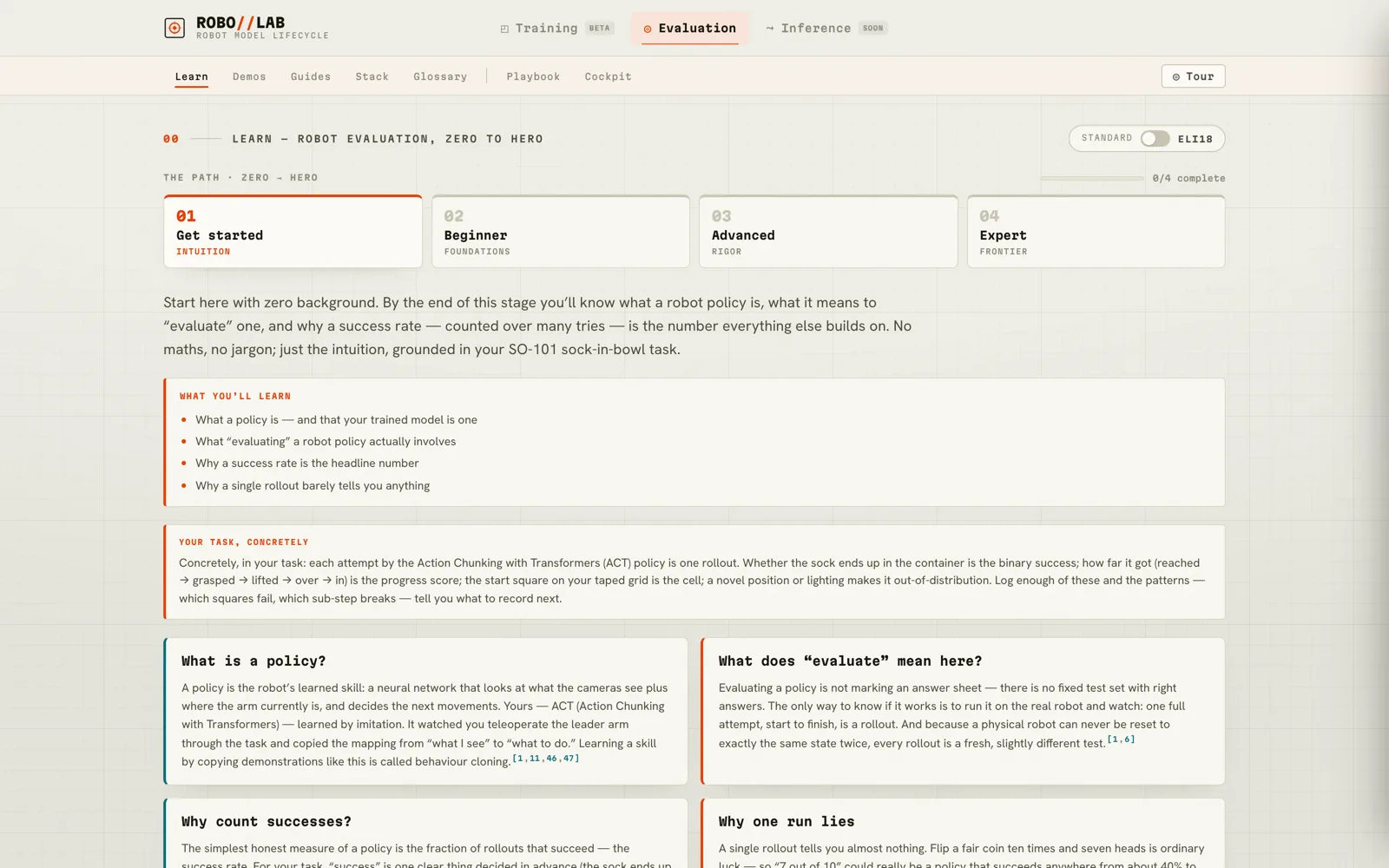
It's also, deliberately, a learning tool. Each area carries its own learning hub, with a step-by-step Learn path with a plain-language toggle, hands-on demos, a glossary, and a directory of about 90 robotics tools. Every factual claim in it carries a numbered citation to the primary sources: the ACT and Diffusion Policy papers, π0, evaluation best-practices work, and so on. I fact-checked the content against roughly 75 of those sources and fixed the four errors I found. Building the instrument was how I made myself actually understand training and evaluation.
How it works
RoboLab doesn't drive the robot or launch training jobs. It's the
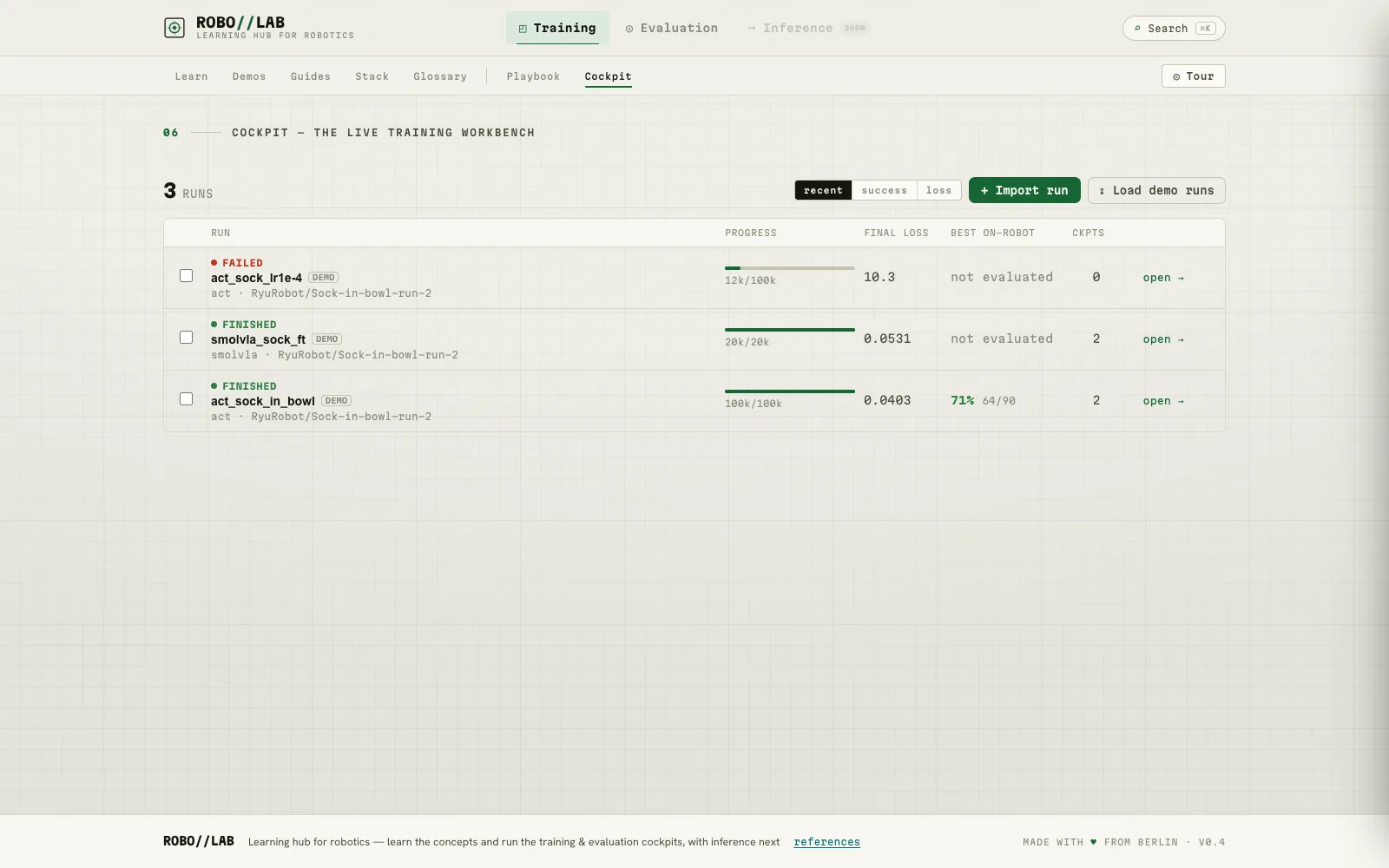
read-and-decide layer over the LeRobot loop. You paste a lerobot-train
console log (or a W&B export) and it becomes a monitored run: loss and
gradient-norm charts, throughput, and a gauge that answers whether your GPU is
sitting starved for data. Paste a dataset's meta/info.json and you get its
episode and camera stats.
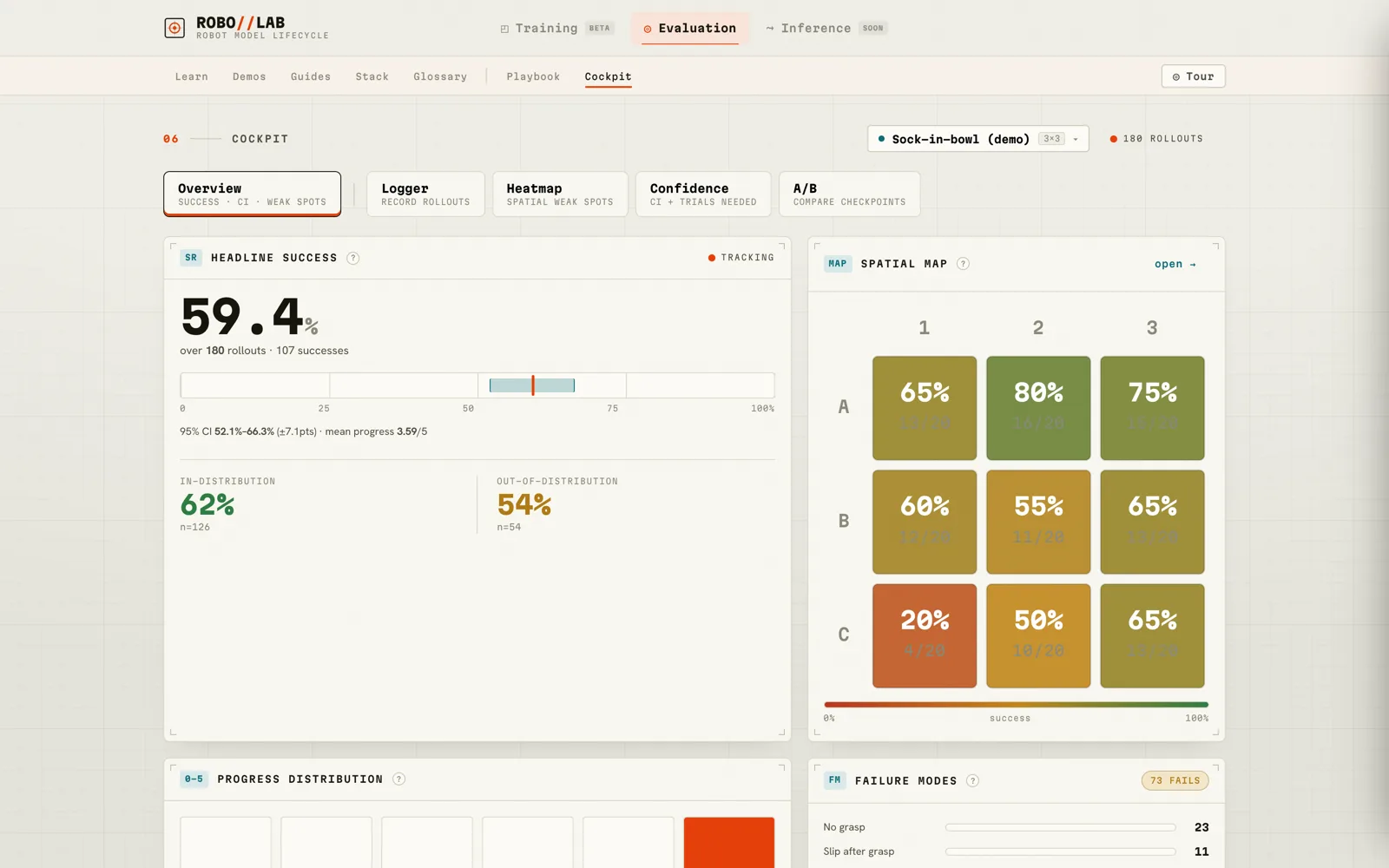
Evaluation is logged by hand, one rollout at a time: where the object was, what happened, any notes. From that it builds a spatial heatmap of where the policy is weak, and puts a Wilson confidence interval on every success rate, because 6 successes out of 10 trials is not "60%". It's "somewhere between 31% and 83%," and pretending otherwise is how you fool yourself. There's an A/B tool for comparing two checkpoints properly, and checkpoints are ranked by success on the real robot, not by loss. Closing that loop, so training decisions are driven by evaluation evidence, is the whole point of the tool.
The stats are implemented from scratch and tested; the stack is TypeScript,
React, Express, and Postgres, and the whole thing runs with one
docker compose up.
Status
Training and Evaluation are live (v0.4); Inference is scaffolded and coming. Full honesty: the screenshots on this page show seeded demo data. The π0.5-versus-ACT evaluation campaign will be RoboLab's first serious real workload, and I'll write that up when it happens. The code is on GitHub, and the longer-term plan is to grow it beyond the SO-101 to other robots.